Digital Communications in Insurance: Where Experience Is Won or Lost
30 Mar, 2026
The 2025 Global Benchmark Report highlights a shift that is becoming increasingly visible across the insurance industry.
Customers are no longer assessing insurers purely on product or price. Increasingly, they are judged on how clearly, consistently, and effortlessly they communicate.
Across the New Zealand market, this shift is already underway. Expectations have moved toward more connected, orchestrated experiences, and insurers who get this right are setting a new standard for trust, retention, and long-term value. Increasingly, this requires coordination not just at the channel level, but within core platforms such as policy administration systems.
What stands out is not just the findings themselves, but how directly they translate into action. When viewed through a practical lens, the report provides a clear direction for improving customer experience without requiring large-scale transformation.
In Life and Health insurance, this matters more than almost anywhere else. The product is largely invisible until a claim or key life event occurs. In practice, communication becomes the experience.
Every renewal notice, policy update, and claims interaction is a moment where trust is either reinforced or eroded.
Communication is Now Core to Retention
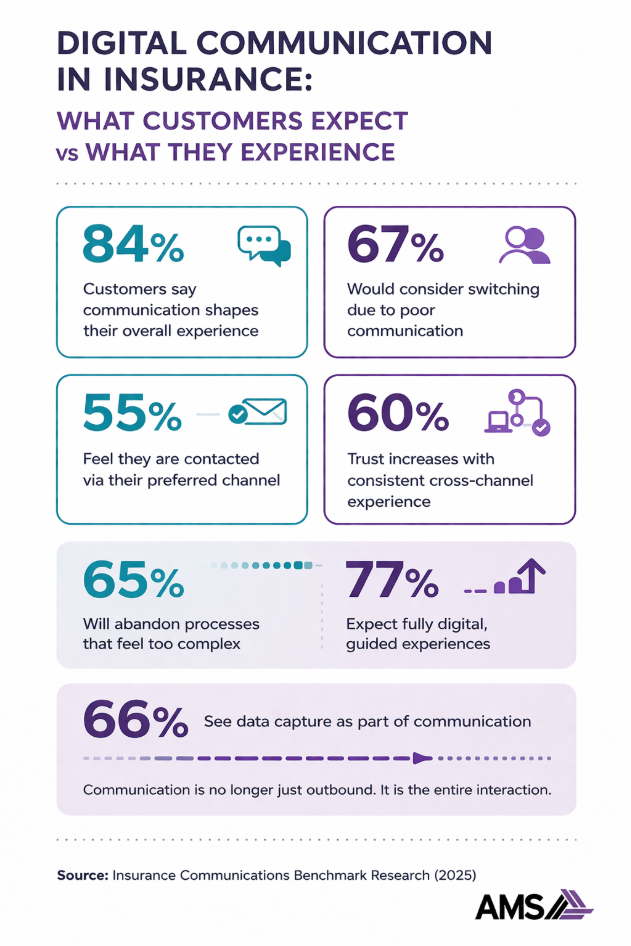
The report indicates that 67% of customers would consider switching providers due to poor communication. For insurers, this presents a clear opportunity. Communication is no longer a supporting function. It sits at the center of the customer relationship.
Across the market, organisations seeing the greatest improvement are those treating communication as a designed experience, not just operational output. Clear, timely, and empathetic interactions are becoming a key driver of retention and customer confidence.
The Coordination Gap Remains
Many insurers have invested in multiple digital channels. Email, SMS, portals, and contact centres are now standard. The challenge is no longer access. It is alignment.
Customers expect these interactions to feel connected. Instead, they are often experienced as separate, disconnected touchpoints, requiring repetition and creating inconsistency.
Closing this gap requires a shift in focus from adding channels to coordinating them. The goal is a single, coherent conversation that moves with the customer across every interaction.
In practice, this is less about introducing new systems and more about how effectively existing platforms are connected. For many insurers, the policy administration system plays a central role, acting as the source of truth for customer, policy, and lifecycle events. Improving how communication and workflows integrate with this core layer is often where meaningful progress is made.
Data Capture is Part of the Experience
The report also highlights that 66% of customers view data collection as a form of communication. This reframes onboarding and information gathering. These are not simply internal processes. They are experience moments that shape how customers perceive the organisation.
Where interactions are repetitive, manual, or unclear, friction increases and engagement drops. Where they are structured, guided, and intuitive, they build confidence and improve completion rates.
Increasingly, insurers are moving toward more intelligent, guided digital experiences that adapt to the customer in real time. This not only improves the experience but also leads to better quality data and more efficient downstream processing.
When connected back to core systems such as the PAS, these interactions become even more valuable, ensuring data flows accurately through underwriting, servicing, and claims processes without duplication or delay.
A Clear Opportunity in New Zealand
Only 58% of New Zealand customers currently rate insurer communication as excellent. This reflects the realities of the local market. Legacy systems, regulatory complexity, and fragmented environments make change more difficult.
At the same time, this creates a clear opportunity. Insurers that can improve experience in a practical, measured way, working within existing environments while progressively modernising, are well positioned to lead.
Across the market, there are already examples of organisations making meaningful improvements by focusing on targeted, integration-led changes rather than large-scale system replacement.
Turning Insight into Action
The direction is clear.
Stronger retention, higher trust, and better customer outcomes will increasingly be shaped by how well insurers manage communication across the lifecycle. The challenge is not understanding what needs to change. It is knowing where to start, and how to make progress in a way that is achievable, low risk, and aligned to the realities of the business.
Start the Conversation
For organisations looking to move forward, the first step is often clarity. Understanding where experience gaps exist, and how they can be addressed in a structured and practical way, can unlock meaningful progress without unnecessary disruption.
If you are looking to improve customer experience without large-scale disruption, a structured, practical approach can help identify where to start.
AMS works with insurers to translate these types of insights into real outcomes, supporting improvements in digital experience through effective integration with core platforms, including policy administration systems, as well as surrounding processes and teams.